Since late in 2021, I have been relying heavily on federated social media, having largely given up on the proprietary alternatives of Facebook and Twitter. It has become a resource that I rely on daily in my personal and professional capacities. I have become a really big fan of this technology, and as with most technologies I get excited about, I have pushed hard to find out what it can do. I want to share with you what I’ve learned in that time.
This was not my first foray into what has become known as the Fediverse — the Federated Universe of social web applications which share identity across many different sites, collectively achieving a distributed social network of services that rivals what the centralized corporate sites can provide. No, I’ve been poking at this for many years now.
A Personal History: The Ancient of Days
First, I want to establish a little bit of my credentials. I am not one of the experts who created this technology, nor have I used it continuously, but I did get involved with it very early and then tried again later. I did not start in 2021 — that was just when my presence on the Fediverse finally really stuck.
My first experience with open source social media would have been with identi.ca, which I joined shortly after joining Twitter, because I wanted to see if I could find a free software / open source alternative (which was very much my thing by 2008, when I was writing earnestly for Free Software Magazine). I was barely aware of the behind-the-scenes changes there, but I do remember some disruption when they switched from status.net (which later changed its name to “Gnu Social“) to pump.io back in the 2000s. I did not really have any understanding of what was happening under the hood with those services, nor what it meant for a package to be “federated”. But I did use them for a time.
After that, I got talked into joining Facebook by family members who wanted to connect there. It became clear that most people were using these corporate platforms, and continuing stubbornly to insist on the free/open-source options started to seem like a lost cause. I “went where the people are”. Sadly, that ended more or less how it was always going to, and I do sometimes wonder if I should’ve stayed with the free networks all along.

In 2011, Diaspora came along with a platform that rivaled what Facebook was doing, and I saw a chance for a breakout. I started an account on a Diaspora server, and rigorously lobbied my friends to come join me “in the Free World”, but very few followed. I found discovery to be very weak on Diaspora, and while I considered the option of running my own Diaspora “pod” (the special Diaspora name for an instance of the software), it wasn’t very clear to me what the benefits would be. I think I still have that account, though I don’t visit it very often anymore.

Google+ came out not long after that, and I tried that as well. I remember being struck by how similar the G+ interface was to Diaspora. Did they copy it? I enjoyed the notion of corporate powers chasing the tail lights of the open source developers and designers. But of course, many more people joined the Google service than Diaspora. Such is the power of corporate marketing.
One frustration with the design of Diaspora is that the authors chose to invent their own federation protocol. So individual Diaspora servers are federated with each other, but they were not able to speak to other platforms. A few platforms have implemented bridges which allow for communication across these boundaries, as I will explore below, but this choice has somewhat isolated Diaspora from later developments.
For the most part, I went back to relying on Facebook and Twitter. I also got a Tumblr account, where the culture was a bit more casual — but I never really got into the Tumblr vibe, and my network there remained very small.
So, I had actually been using Federated Social media years before Mastodon was written, let alone when it came to dominate the ActivityPub Fediverse that has since grown up. But it was not until 2021 that I joined a Mastodon instance and committed to moving my flag from Facebook to the Fediverse.
 So, I’m both old and new at this, because the landscape has been continuously changing. And it is still changing rapidly. New platforms are being created (for example, Loops and Wafrn, both of which have arrived on the scene in 2025), while others have disappeared (like Meisskey and Foundkey, which are Misskey forks that are no longer maintained). I realized in preparing for this article that it would be hopeless to try to write an exhaustively complete guide to the Fediverse. It’s too large, too complex, and too rapidly moving for me to get close to that.
So this will be my personal guide, emphasizing platforms, protocols, and projects that I have found interesting, with a particular emphasis on the ones I have used.
The Promise of Federation
What Federation actually does is a little hard for most people to get their heads around. I think it helps to show a practical example of what it means, particularly when we are crossing from one platform to another.
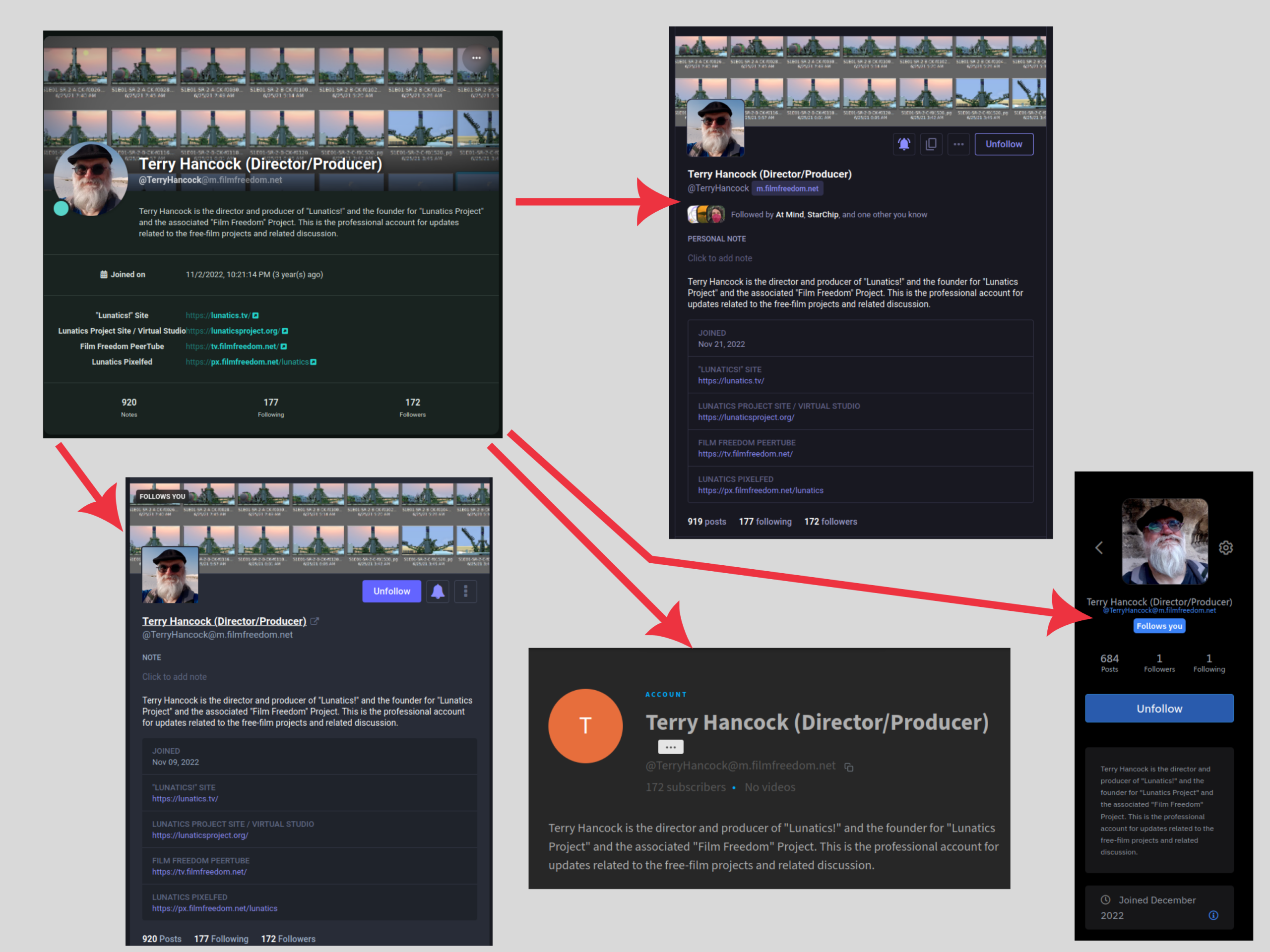
As you can see in the illustration, there is a fair amount of consistency in appearance for a profile across different platforms. Here we see my original self-hosted Misskey profile (at m.filmfreedom.net), as it appears on Mastodon (at mstdn.social), Hometown (at realsocial.life), PeerTube (at tv.filmfreedom.net), and Pixelfed (at px.filmfreedom.net). All the “filmfreedom.net” domains are also self-hosted. I generally follow all my other accounts from each to make it easier to boost posts across different friend circles, although there is enough cross-over that I try not to do this all at once. And the same happens with every post, of course.
This is the central magic behind the Fediverse. You post in one location, with one account, on one instance, of one type of software — but everyone connected to the network can see it.
This statement is just a little bit of a lie, as we’ll see when we get into details, but it’s a good starting point. It is the promise of federation.
Mastodon or Fediverse?
Unfortunately, a lot of the general public has caught onto the existence of the Fediverse solely through a single federated social media platform: Mastodon.
Mastodon is a good piece of software, it probably deserves its status as the most popular federated microblogging platform. It is probably the nearest of the federated platforms to the proprietary Twitter, whose new ownership and name change to “X” was a major motivator for many people to finally try out federated media. Many were disappointed, sometimes because they missed the very features that may be responsible for Twitter’s dysfunctions, and in some case, the dysfunction itself seemed to be what they missed, particularly if they were among the celebrity class who made their reputations (and sometimes wealth) on the basis of the mythic “Algorithm” that drives engagement partly by favoring popular accounts and making interaction more lopsided than it naturally is.
On the other hand, for many of us whose presence on algorithmically-selected media like Twitter and Facebook was only mediocre, the more organic behavior on Fediverse platforms with more conversational communications styles and with more modest followings, the Fediverse was a huge improvement. We’re still very much a minority in the social media universe, and yet being on the Fediverse feels at least as good as those other platforms, even if a lot of our “real life” friends aren’t on here with us.
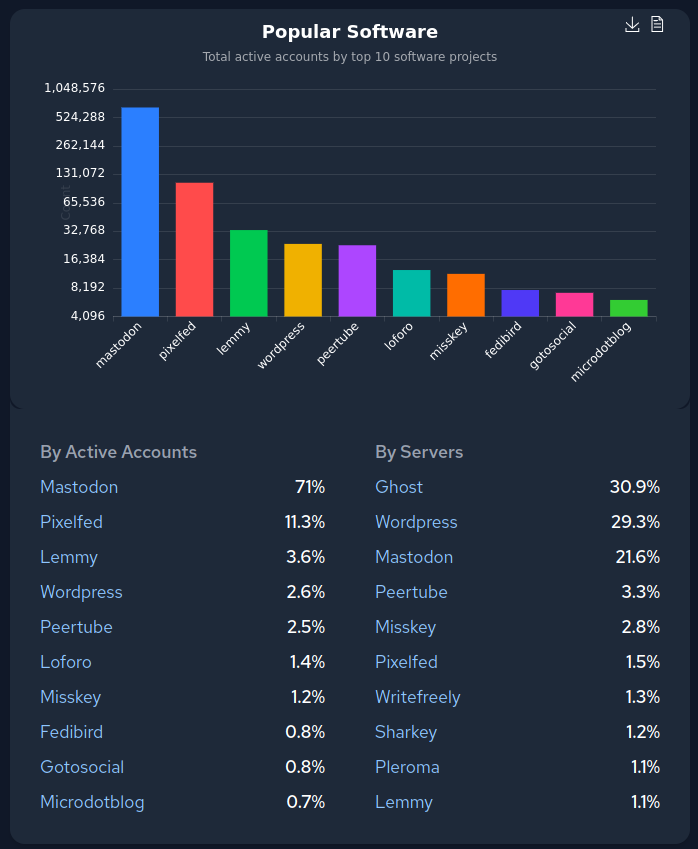
The point really is that, although Mastodon is undeniably the Fediverse’s “killer app”, there is a very long tail of other software in this network, which is also very important. Another potentially complicating factor is that some software, like Misskey, is notorious for being the basis of specialized forks: such as “Foundkey”, “Sharkey”, “Firefish”, and “Iceshrimp”, which are still all basically “Misskey” at heart. Similarly, Mastodon has a number of popular variants as well.
I tried to make a chart showing the family trees of the most popular Fediverse platforms, but I found that things were complicated by a number of factors. For one thing, a software platform for the Fediverse actually consists of multiple software components, and while “Mastodon” packages these together, some forks only take over part of the problem, leaving other software to take over the other jobs. As a result, diagramming this gets complicated. But here’s is a family tree of three very popular microblogging software packages, along with some of the clients that work with them.
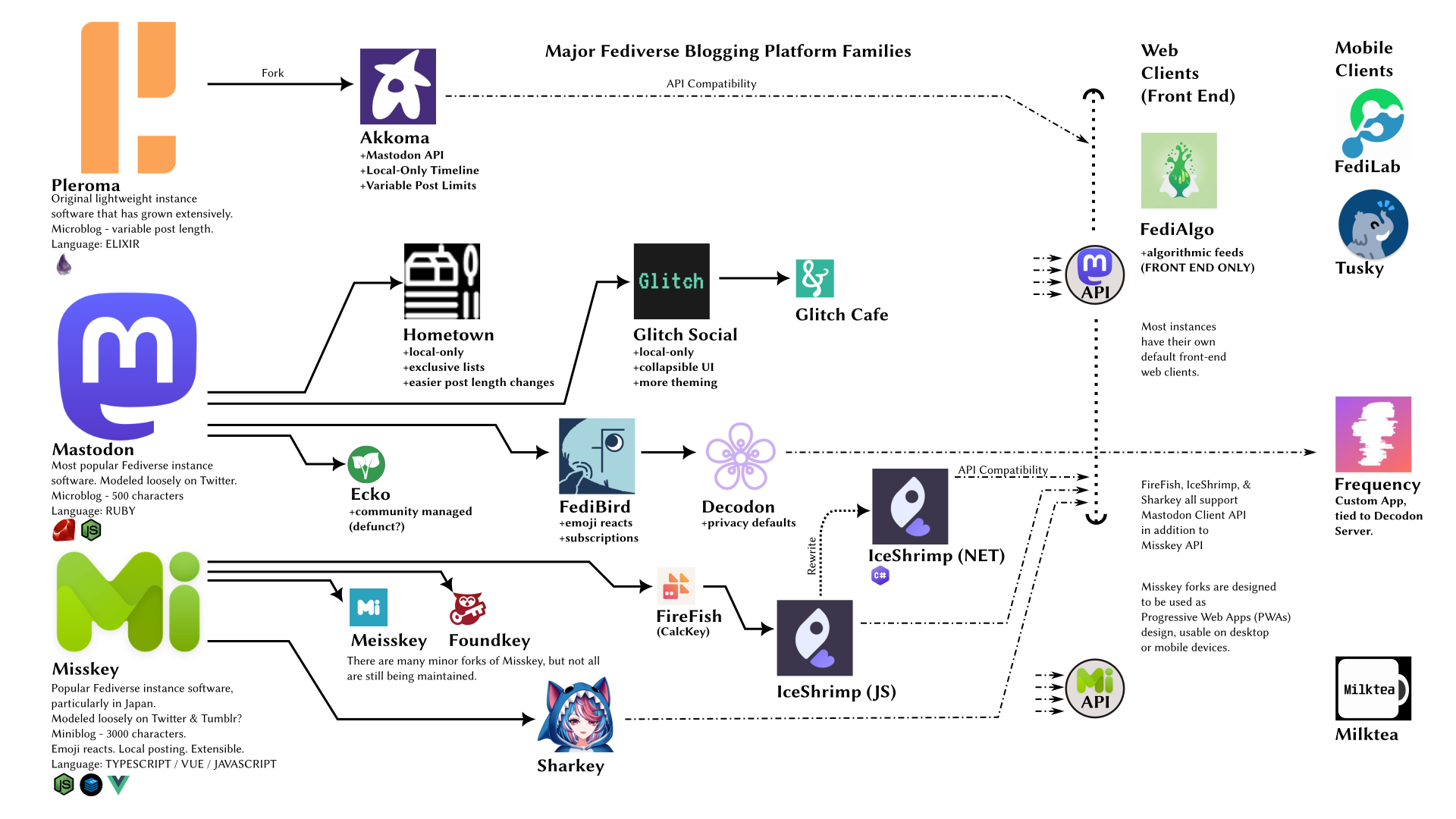
This shows three important families of Fediverse software: Mastodon, Misskey, and Pleroma. It shows various other popular software that are simply “forks” (variants) of the originals. So, for example:
Mastodon Forks
Hometown – adds local-only posting, exclusive lists (since added to Mastodon’s main branch), and easier adjustment of maximum post length.
Glitch-Social – local-only posting, formatting, themes, and UI changes.
Since these were forked, some of their features have found their way into Mastodon-proper, so the distinctions may have faded, and yet they still continue, with their own minor UI differences and fans who like them.
Other forks are not nearly so popular, but remain of interest to some niche or other, such as:
Fedibird – emoji reactions, quote posting, subscriptions, more post expiration options.
One of the major complaints about Mastodon, though, is that it is a relatively heavy piece of software, and needs to have a big server with plenty of RAM and disk cache space available. This makes it a poor choice for very small communities.
Pleroma Forks
Some of the other popular platforms do much better for small instances. Of these, Pleroma has acquired the reputation of being very popular for single-user or limited-user instances.
Akkoma – Akkoma is a fork of Pleroma that introduces a lot more flexibility in user interfaces and appearance.
Misskey Forks
Perhaps the most infamous of the platforms for producing forks, is Misskey. Misskey is actually slightly older than Mastodon, as a forum software, although it acquired federation slightly later.
Also, while Mastodon originated in Germany, accounting for the large number of German users you’ll find on the platform, Misskey is originally Japanese. For English-speaking users and system-administrators, this does raise some issues: there is English-language documentation, but it’s not nearly as complete or up-to-date as the Japanese. This alone is a reason for forks to exist, but there are other reasons, too.
It is implemented largely in Typescript on the client side. The in-browser client software is quite a bit heavier than Mastodon’s, and can do a lot of silly tricks. But also, this means that less work is required on the server side.
Compared to Mastodon, Misskey is significantly lighter to host, although not quite so much as Pleroma. It’s a good compromise in terms of hosting requirements and capabilities, and that’s why I’ve been using it as my self-hosted “professional” instance (which is nearly single-user).
Misskey has its own API for interacting with client software, as well. And this means that mobile software such as “FediLab” or “Tusky” that are designed to work with Mastodon will not work on a Misskey instance. There is a “Milktea” mobile client for Misskey, but I’ve never gotten it to work on my phone.
One answer to that is provided by forks of Misskey that add support for the Mastodon API, including Sharkey, Firefish, and Iceshrimp (which was forked from Firefish, mainly due to maintainence issues with it).
Software Components
Another source of diversity in the Fediverse environment are the broken-down components of each platform. With a proprietary platform like Twitter, the word encompasses several distinct things: the “Twitter” company, the “Twitter” instance (a single community, operated by that company’s datacenters), the “Twitter” website / web application (what you access from a web browser if you visit the “Twitter site”), and also the “Twitter” app that you might use on a mobile device like your Android or iOS smartphone.
For the Fediverse, these can all be separate, interoperable components! There is not one singular company, instance, website, or app for the Fediverse. Each of these is a matter of personal and community choice.
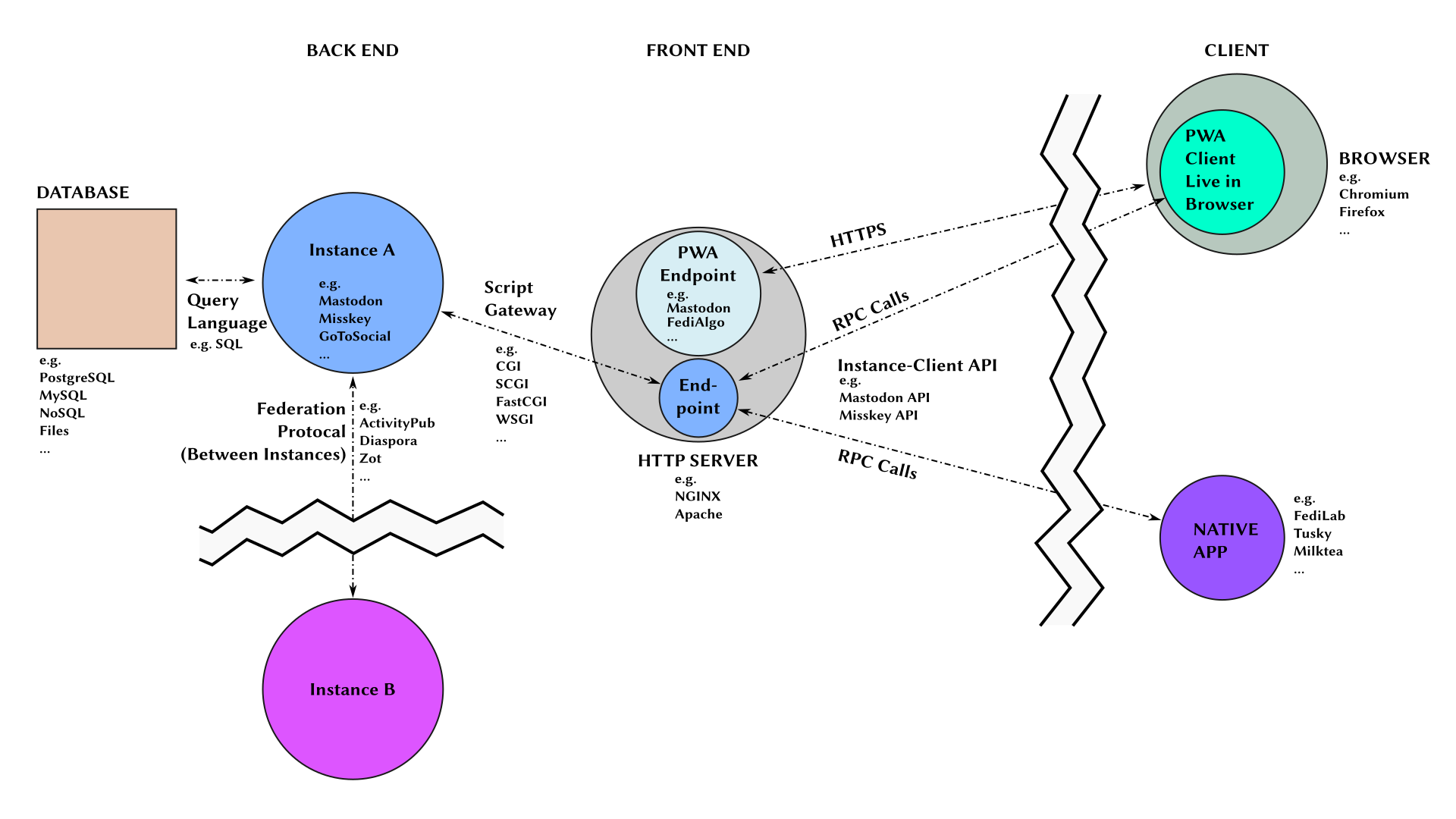
This will be important when we go further afield to discuss software, because some platforms use a different breakdown than others, often providing only a portion of these components, relying on you to fill in the rest. For example, “GoToSocial” has no HTML/web front end, so you have to either use a native client app or use web-based client front-end with it.
Federation Protocol: ActivityPub
Federation is a generic concept, and there is more than one federation protocol. However, by far the most-used is called “ActivityPub“. Most of the Fediverse apps I’ll be discussing here use it, although a few can also use other federation protocols, including “Diaspora” and “Zot”.
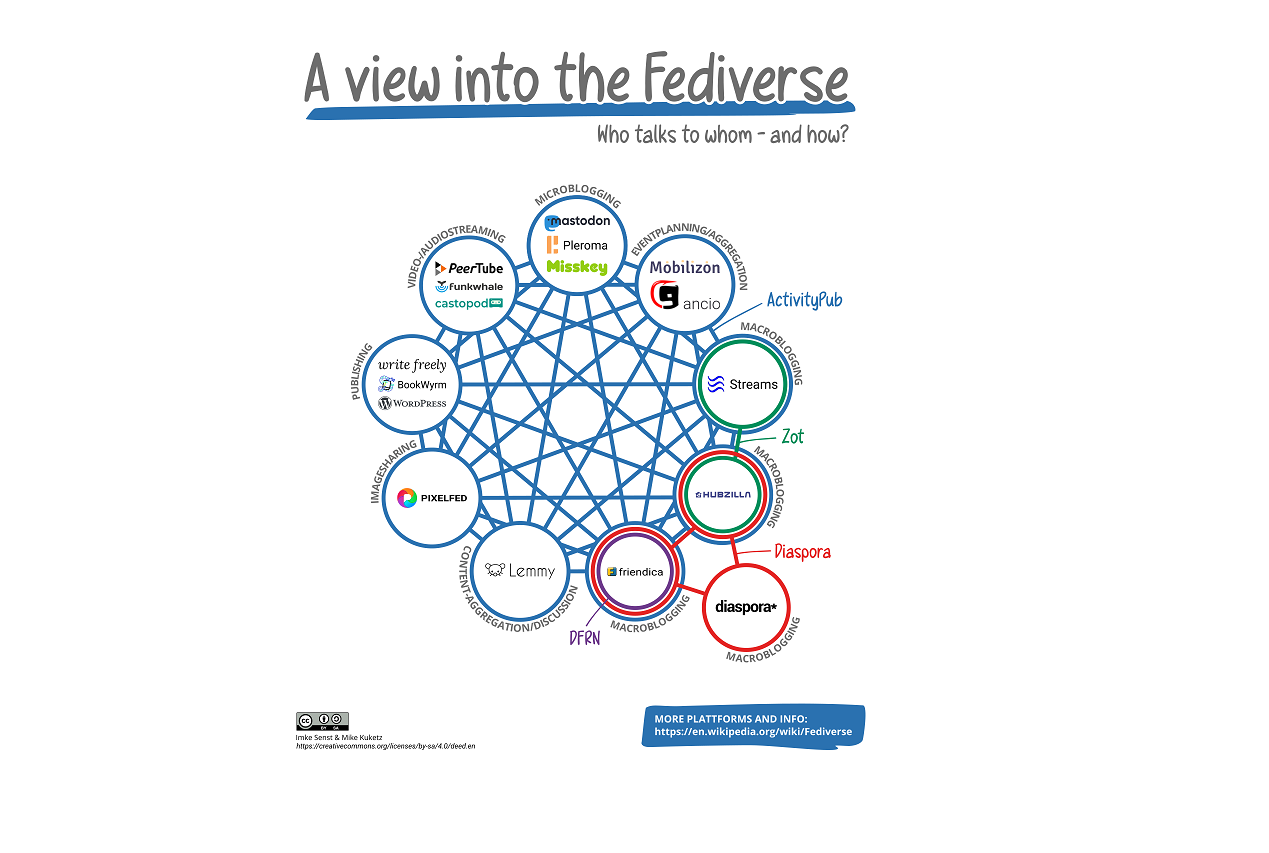
There is some ambiguity about whether the “Fediverse” encompasses all of these, or only those that implement ActivityPub federation. Some use such distinctions as “Inner Fediverse” for AP-based servers, versus the “Outer Fediverse” for the others. I am not aware of any actual standard usage here, so you’re free to pick your own.
Smaller and Customized Instances
These platforms are still generally targeted at small digital fiefdoms — a computer-savvy system administrator sets up a self-host server or contracts a turn-key solution from a larger company, and then administrates the site for users who join it. This is a pretty good model, which suits a lot of people — and it’s much easier to be a user on a site with other people responsible for moderation and administration.
But for people who really want to focus on very small or customized instances, there are even smaller, lighter solutions.
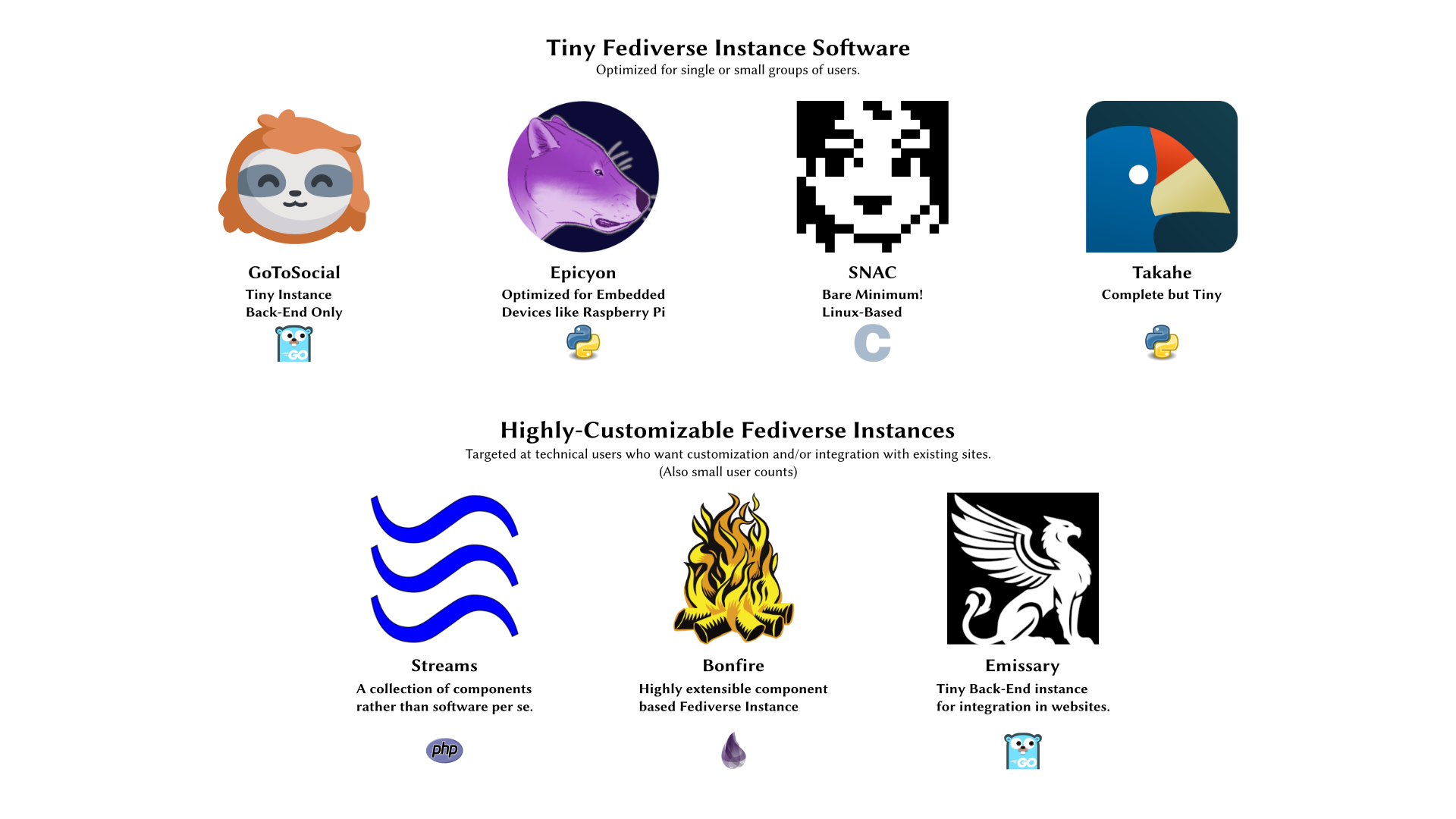
For those who want to run a Fediverse community (or single-user platform) on even more limited hardware, there are some Fediverse platforms that are targeted to this niche:
GoToSocial is a complete microblogging site, with Mastodon API support, but no front end, specifically targeting the single-user case.
Epicyon is designed for single-user and bot applications, even running on very limited platforms like Raspberry Pi embedded computers.
SNAC is complete, but minimal Fediverse implementation in C.
Takahe is meant for small installations, but supports multiple domains.
And then there are the Fediverse library and framework packages that are intended to be used in custom/bespoke web applications of your own design: Streams, Bonfire, and Emissary all fit in this category. They are highly configurable, to meet your individual community needs.
Sadly, sometimes the reason a person wants a single-user instance is because they keep getting kicked off of larger instances for violating their terms and/or community rules. So there are people who find it suspicious if you are on such a smaller server. But of course, there are many reasons to want your own instance in the Fediverse, so this is probably not a great prejudice for people to have. But it shows how the mere fact of federation has an impact on social interactions.
Fediverse Platforms By Application
So far, I’ve only talked about “microblogging” platforms. That’s the generic term for platforms like “Twitter” and “Tumblr” that are mainly about many users sharing short texts with each other.
But federation can work with a much larger array of socially networked applications!
Broader Fediverse and Beyond
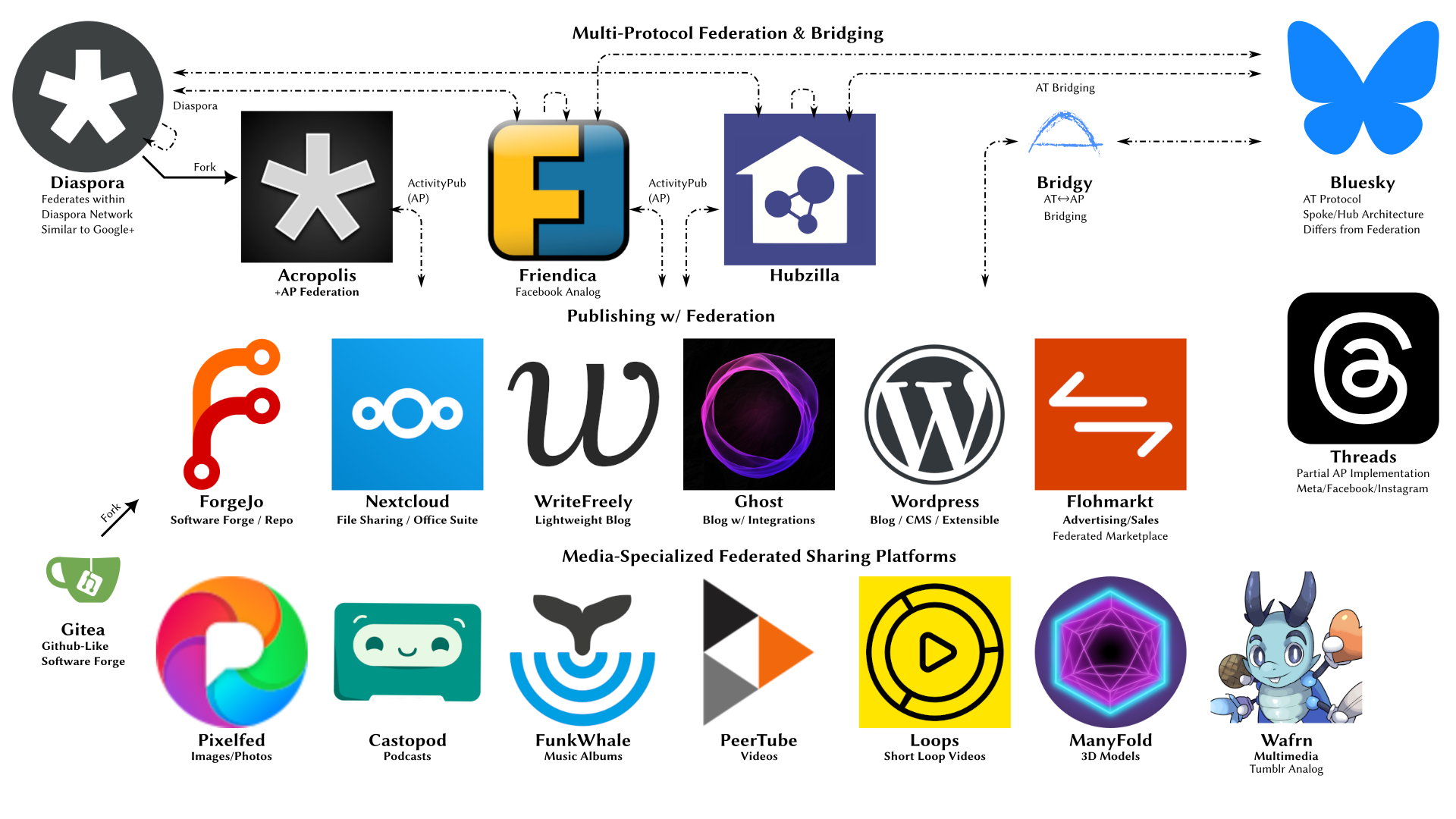
Beyond the world of microblogging, there are also platforms that extend your capabilities. I’ve already mentioned Diaspora, and the problem of it not sharing the ActivityPub federation standard. There is a fork, called Acropolis that remedies this. Likewise, Friendica and Hubzilla are “macroblogging” platforms that support longer posts and also improved connectivity, offering compatibility to other federation protocols, and even access to the BlueSky platform (which is not part of the Fediverse at all, being organized quite differently).
Publishing and Collaboration Platforms
There are a few full-fledged blogging platforms, which have federation and thus can be followed on the Fediverse:
WordPress initially connected through a third-party plugin, but now includes this with the usual distribution.
Ghost likewise implements some federation capabilities now.
WriteFreely is a very light-weight blogging platform using the markdown syntax, and has had federation as a key feature from its beginning.
Other platforms exist mainly to facilitate collaborative projects:
Forgejo (forked from Gitea) is a Git-based software forge, which has federated connections, allowing multiple forges to coordinate as a single community (to some degree).
Nextcloud is a file-sharing and groupware platform which allows for federated sharing and connections.
Flohmarkt is a federated classified-advertising marketplace.
Media Sharing and Publishing Platforms
And then there are multimedia-centered applications, which are broken up primarily by the kind of media they facilitate sharing:
Pixelfed: for photos and other images (compare to Instagram, Flickr, or Snapchat).
Castopod: podcasts.
Funkwhale: music albums and other sound collections (compare to Spotify or Jamendo).
PeerTube: general video and streaming content (compare to YouTube or Vimeo).
Loops: short-form video loops (compare to TikTok or Vine), created by the author of Pixelfed.
Manyfold: 3D models for printing (compare to Thingiverse).
Wafrn: a Federated platform aiming to work for many kinds of media (compare to Tumblr).
Lemmy: is a link aggregator and review platform (compare to Reddit).
Of course, it should be noted that images can be shared on microblogging and macroblogging platforms, too. So you might think of these platforms as being more specialized around those media-publishing applications.
Also, I list some comparable sites, but please understand that no alternative will behave exactly like another, nor should it. In particular, the fact of federation implies some different behaviors and user culture, as we’ll see below.
The Potential is Not Fully Realized Yet
This is a powerful system, and the full potential has not been reached. There are many applications for which there is no widely-accepted protocol or federated platform, but there could be!
My favorite to consider is e-Commerce. I see no practical obstacle to a federated platform that would allow thousands of individual internet storefronts to cooperatively present a marketplace platform equivalent to e-Bay or Etsy or Amazon, without the help of a centralized corporation to manage it. Such a thing could be a major power-amplifier in a world dominated by capitalist markets. There are many details, and the simple fact of payment processing would create some bottlenecks, but carts and catalogs could be federated so that the customer might seem to shop in all the thousands of stores at once.
I’ve also recently seen requests for a better platform for serial publications, like web comics. This is actually pretty close to what I created for publishing Lunatics episodes. Which makes me wonder if I should figure out a way to add federation to LunaGen (it’s a static site-generator, so I suspect there’d be a lot of work to do there!).
Hosting Your Own Fediverse Community
There are a wide variety of options for hosting a community yourself, and for a small or even modest-sized (say, less than 1000 users) site, the cost is not that prohibitive.
Consider these three possible approaches:
Rent a turn-key Fediverse instance. A number of cloud-services providers will rent you a Mastodon or other Fediverse instance, ready for use. They keep the software running; you administrate and moderate. This is what we are currently doing for the realsocial.life server that I use for personal posting. We rent that from Fedi Monster in Germany. Another popular provider is Masto.host (as I write this, Masto.host is advertising $6/month for a starting site). These are typically very low-maintenance and do not require much technical skill, but they do limit what software you can run.
Somewhat less simple is to rent a “Virtual Private Server” (VPS) from a cloud-service provider, and install software on that. For us, the YunoHost platform makes this extremely easy to manage. It contains most of the complexity by provide a large collection of web application package that can be installed and run with nearly the simplicity you expect from a desktop Linux distribution. YunoHost is a distribution based on Debian Linux. A lot of Fediverse software is included, though not all. I used the YunoHost app catalog as an important source in writing this article.
If you are even more comfortable with IT work, you might be up for using container distributions, with Docker or Kubernetes. This is a little out of my comfort zone, and I don’t use this, but almost every Fediverse package is available as a container distribution.
And obviously, you can just install the software directly, although this can be a pretty challenging project, due to limited documentation and testing.
The Corporate Powers: Threads and BlueSky
There is probably no more certain evidence that the Fediverse has become important than that major corporate entities have noticed, and made some effort to muscle in — but also maintain the level of manipulative control they are used to.
They are viewed with considerable distrust by many on the existing Fediverse, but I still think it is important to consider them.
One of these, Threads, is definitely, at least partly, part of the Fediverse. Meta’s “Threads” platform is an ActivityPub-enabled component of the Facebook/Instagram/Meta conglomeration. I have not really seen what this looks like from the other side, but I do see posts federated from Threads.
It is an unequal connection: Threads users do not necessarily see all of the interactions with their posts on other platforms. It apparently takes some effort for them to do so. So Meta has maintained a degree of control and encirclement of their users in this way.
But for those on the outside, it is a way that we can keep up with some of the “normies”: a lot of corporate and celebrity accounts exist on Threads, and thus I can keep up with Jeri Ryan of Star Trek Voyager fame or journalists like Molly Jong-Fast this way, even though they don’t have more “proper Fediverse” accounts.
BlueSky is definitely not part of the Fediverse in a technical sense, although it might be a bit more aligned than Threads, ideologically. It is said to be “distributed”, but this is in a much less substantive way than federation, due to the structure of the AT Protocol it is based on.
In a technical sense, the Fediverse is an alliance of peers, whereas BlueSky is much more of a hub-and-spoke system, with powerful centralized authorities moderating interactions. It will never be as robustly distributed as the Fediverse for this reason, and it will always be more subject to corporate manipulation (a technically-accurate description of the architecture is complicated, and out of scope for this article).
However, despite the architectural incompatibility, there are bridges that allow BlueSky and the Fediverse to interact. So I also follow a number of accounts on BlueSky via these connections. Mike Masnick of TechDirt is there, for example.
The corporate platform has advantages for professionals, and BlueSky has been more popular for many journalists and artists than the Fediverse.
I maintain that this is a precarious situation, however — BlueSky is still very much subject to corporate control, and it is more a matter of current politics and strategy that they have not (yet) followed suit with Twitter or Facebook to become a ruined, manipulated, extractive engagement-farming wasteland. There are none of the inherent structural defenses against such dark patterns that are intrinsic to the Fediverse. BlueSky is a “benevolent dictatorship”, not a “liberal democracy” nor a “free market” — its benevolence can vanish in a heartbeat.
Life Without the Algorithm
Much of the complaints about the big corporate social media platforms have to do with the manipulative impacts of “The Algorithm”. What this means, is that these platforms select what posts to show you, based on some unspecified, proprietary algorithm, typically relying on content analysis, relationship graphs between users, and so on. This approach puts power to move minds into the control of artificial intelligence, managed by the perversely-incentivized power of the billionaires who own the platforms.
Indeed, this is largely their reason for existing. Such corporate platforms essentially exist to sell us, the users, to corporate clients for advertising, market manipulation, and so on. Your identity and your attention is being characterized, sorted, packaged, and sold.
The Human Algorithm
You’ve probably already heard it said that, on the Fediverse, there is no algorithm.
That’s not strictly true, of course. It’s just that the algorithm is very simple, easy-to-understand, easy-to-modify, predictable, and not designed to manipulate you for outside interests. You are in control of it in many ways.
You see posts in the order they are posted and federated to your instance, based on whom you follow, and whom they choose to promote through “boosting” (as it is called on Mastodon — other platforms may use different terminology: on Misskey this is a “renote”).
And so, WE are the algorithm on the Fediverse. This is why it is a public benefit for you to boost content you think your followers would like to see. You can control your own “human algorithm” by following posters who boost content that interests you.
This is a much more equal relationship than you get on Facebook or YouTube where the “suggested” or “popular” or “for you” content is selected for the benefit of their real clients — companies that pay them to promote certain kinds of content. Or indeed, content that is simply intended to keep you “engaged” (which can mean scrolling happily through shallow content or intensely arguing with other users who disagree with you — as long as you stay hooked, the corporate platform is satisfied).
Much of the “toxicity” of corporate social media derives from algorithmic post selection and the perverse incentives these companies have to manipulate you to serve their ends. This has ranged everywhere from mass social experiments to manipulation of elections to breaking up families to promoting AI slop, commercial spam, and other unpleasantness.
For many of us, it got to be too much. And the Fediverse is our answer to that. Because its structure defuses the perverse incentives and frustrates top-down control, it is unlikely to fail in the same ways.
However, intentional manipulation is not the only problem with corporate media. They also fail in accidental ways, simply because they can’t really handle the load they have created for themselves.
Where Are All My People..?!
There is one big disadvantage to lacking the Algorithm: it’s not working to collect similar groups of people together. If you are in a minority group, then that was helping you to find your peers on the corporate platforms. Here on the Fediverse, without this help, they will appear much more diffused, and it will take more intentional effort to find them.
The algorithm is also not confining your posts to a friendly audience, so there’s a greater chance that you will have interactions with people outside of your immediate community. That can lead to some toxic behavior.
Context Collapse
A funny story from my time on Facebook: I once made a brief post in which I lamented “There needs to be more science-fiction with girl protagonists“. Of course, people in my friend-circle on Facebook would understand this pretty well. I am engaged in producing a story with a 7-year-old girl protagonist, and also had a young daughter I wanted to read science-fiction stories to, preferably with relatable protagonists.
Well, this got shared outside of my friend group, and I started to get weird pushback from people deeply offended that I was “infantilizing women”.
You see, with no context, they just assumed that when I said “girl”, I meant “woman”, and they had Big Feelings about this! This would’ve been cleared up if they actually read the original thread before commenting (but the more they commented, the harder it was for them to see the early comments).
Sadly, the Fediverse is even worse about this. Federation means that if you make a popular post and it starts to go viral (or “fungal” as some have suggested), it will get boosted onto very different communities with very different contextual assumptions, and this is an endless source of “reply guy” posts on the Fediverse, especially if you are a popular-enough poster to get boosted a lot (which is probably why we hear more complaints about this sort of thing from celebrities).
To be a good Fedizen, you should probably have the grace to realize this may be happening to other people as well, before you leap to conclusions about their intent.
Lazy Federation Surprises
One source of weirdness and surprises comes from the way that Federation actually works. I said above that it’s a little bit of a lie.
The presentation makes it seem as if the “federated” feed is the whole of the Fediverse, but that’s not actually true. It can only show the posts that it is aware of, and these are not a complete survey of the entire Fediverse. That would be effectively impossible. Your server would have to know a list of all servers to poll — there is no such list, because there is no top-level directory of servers. Anyone can put a server up, and you find out about it because you look for it. And then your server becomes aware that that server exists.
But it doesn’t even do that. Your server only queries the servers of accounts that someone on your server follows. On a big site, like mastodon.social or mstdn.social, that’s a very long list of servers and accounts on those servers. So it looks pretty global.
But it’s not. And the situation is much more acute on smaller community instances, because there are fewer people expanding the federated networks.
Incomplete federation produces some weird behavior — one might say “pathologies” that can be treacherous for users, and so you really ought to become aware of them.
Empty Profiles and Missing Comments
Another consequence of incomplete federation is that sometimes, particularly when you first encounter a new person on your feed, who has been connected by federation, a lot of content will be missing.
When a post comes in via federation, you initially only see comments on that post that your server is already aware of: that is, posts from other users on your server, or other people whom you follow. This can make their thread seem empty, when there’s actually been a roaring conversation going on over there.
If you see a person out there, posting a complaint about some problem and “not getting any help”, you might feel a humanitarian urge to try to offer something to them, even if you aren’t very knowledgeable. You lack expertise, but you start to think “maybe I’m the best option available”?
Stop, friend, and think! You might be about to become a “reply guy”. In fact, from the poster’s point of view, they may see a storm of shallow responses to their post, motivated in the same way. I have experienced this from both sides!
Also, if someone sends a follow request to you from a remote server, you might look at their profile and find it suspiciously empty. Is it a bot? A spammer?
Well, maybe. Those do exist on the Fediverse as elsewhere. But it could also be a full-fledged user with a profile and posts that simply hasn’t percolated through the network to your server yet.
In both cases, there is a useful tool, via the “…” button on posts (on Mastodon’s web interface, anyway): “Open Original Page”. This will let you look at how the post (or user profile) appears on the server they are hosted on. This will usually be a much more complete picture.
More recent Hometown and Mastodon releases have improved on this situation by adding a feature to poll the original server for additional comments, when you click on the post to see its thread. You may see a “Fetch more comments” button. This is definitely useful if your server has this feature.
Fediverse Relays
Poor federation is a bigger problem for smaller community instances, and especially bad for single-user instances.
Wouldn’t it be nice there were some automation to replace the effect of all those other users pumping federated posts onto your server?
Well, there is. That’s called a “fediverse relay”. I won’t explain this in detail here, but it’s something to look for if you’re going to self-host a small instance.
Be careful to vet it well, though: relays have personalities, just like communities do. Some may be relaying content from a lot of toxic site, and you want to avoid that!
Account Migration
A big part of the promise of the Fediverse is no lock-in to your platform. If you want to move to a new one, you can just go, and still retain your old connections.
Federation partially solves this: if you move to a new server, you can simply download the list of people you follow, and then upload the follow list to your new account, and voila! you are following all the same people.
But, importantly, they are not following you anymore. Because, see, whom they follow is their choice, and you can’t make them do that. It is also encoded as a list on their server, not yours.
The solution for this, which is generally called “instance migration”, is actually more accurately described as forwarding.
What happens is that the server you left maintains a profile for you, but that profile tells visitors, “Hey, I’m actually on this other server now.”
So as long as that is maintained, people who follow you will poll the original server, get the forwarding information, and then go find you on the new server. So you stay connected!
On Mastodon.
I had a big misconception at one point that this was a general Fediverse or ActivityPub feature, but it is not. It was a feature of Mastodon in particular. Some other servers, such as Misskey did not provide this feature.
Which means, I could migrate from a Mastodon server to Misskey server (which I did), but I could not migrate back to a Mastodon server (or even a different Misskey server) from my Misskey instance. It was a dead-end — a trap! Oh no!
I fretted over this for quite some time. Fortunately, the idea has caught on, and current versions of Misskey do support instance forwarding, so migration is once again possible for me (but now, paradoxically, I don’t need to move as much, because I can do it later if I want).
What About My Posts?
A common lament is that Mastodon does not carry over your posting history when you migrate. Your new account will appear to have no history after you move.
In principle, this can be addressed by sending your old posts from the old server to the new, back-dated so they occur in correct order (which will notably put the post date prior to your membership date, which might seem odd).
In practice, though, the popular Fediverse servers don’t do this.
However, it was one of the features introduced in “Calckey”, a fork of Misskey, which then changed to FireFish, and then then to IceShrimp. And I think it might have been ported to Sharkey, as well. I only know of this second hand, and can’t report on how well it works. I’ve been meaning to look into it.
Distributed Governance
The nature of the Fediverse as a vast array (tens-of-thousands at this point) of individual communities means that there is no one big, centralized, controlling authority to appeal to for moderation or administration issues. This has a few disadvantages, but these are generally outweighed by the advantages.
Moderation is Local
Moderation is local. When you raise a moderation request on Facebook — when you complain about someone else’s post or they complain about yours — you are dealing with a faceless corporate entity. You don’t know them. They don’t know you.
Not so on a modest-sized Fediverse server. Here, the moderator is someone you likely hear from on a regular basis. You get to know them and you learn what makes them tick — what’s allowed, what’s not allowed, and how they are likely to react to things.
One of the things I’ve heard new Fediverse users are most surprised by is how fast moderation typically is here — especially on a smaller community (the big servers like mastodon.social are not quite so impressive on this front, though probably still quite a bit better than on the big corporate social media sites).
This is really just a simple matter of size: your community size is what determines the load for moderation, and if it’s not too large, the management is likely to be good.
What’s more, the moderation is likely to be more aligned with your values if you have joined a community that you have an affinity for. I would say this is one of the most important aspects of choosing a community, although you probably shouldn’t waste too much time before joining. it’s perfectly valid to join a big Mastodon instance like mastodon.social and then migrate to a smaller, better-matched one afterwards (I’ll get to what this means in just a bit).
Moderation is Federated
Your community on the Fediverse will have its own rules for moderation. Acceptable codes of conduct. Content limitations. And so on. And these will be different in different communities.
And that, of course, is where things can also get sticky: because what if you are perfectly in compliance with the rules on your server, but your content is getting into the feeds of people on a different server with very different rules?
Here we sometimes get into some high-level conflicts. If you get into a hot-button political area or take the “wrong” side in a war somewhere in the world, you just might trip over somebody’s red line. Indeed, not just the person reading your post, but perhaps their whole instance and the moderators on that instance.
At that point, your local moderator will forward the complaint back to the origin server (or they will receive it, if a complaint was made against you on that other server). This will go to a moderator there, and they will evaluate it according to their community’s standards. If they feel the content is within bounds for their community, then your complaint will be ignored on their side.
Irreconcilable Differences
In the case that administrators fundamentally disagree on what’s acceptable, you or your moderator can block that user or even that whole instance.
If things really start to break down, because different communities have differences too strong to smooth over, then your site administrator may decide to “limit” the server, making their content hidden unless you expressly choose to interact with it. Or if that’s not sufficient, they can fully block or “defederate” that server.
That’s a fairly violent move to make, so administrators usually reserve such actions for sites they view as genuinely toxic, through a lack of effective moderation or because the site’s values are themselves fundamentally toxic.
Since there are broad areas of agreement over what are considered “toxic” sites (usually eliminationist rhetoric, threats, cyber-bullying, and so on), there are organizations above the instance level, such as TheBadSpace and IFTAS, who provide references and tools for administrators to use to block toxic sites on the Fediverse.
This does not destroy those sites. It merely makes them invisible to users on the sites using these block lists. So, it is possible for fundamentally incompatible archipelagos of Fediverse sites to exist, wholly cut off from each other.
Or for there to be only a few sites that bridge between them. There are a few instances who pride themselves on free speech and professional neutrality in such differences, as opposed to the more common belief that communities should protect against harmful behaviors.
No Lords, No Masters, No Kings
There is no ultimate authority here to appeal to. The software is free, the protocols are open, so there’s very little basis to fully shut down a toxic platform. Instead, it is shunned.
This is what happened to Gab, for example, which was an explicitly right-wing platform on the Fediverse at one time. Similarly, Truth Social is a Mastodon-based platform, with federation turned off.
If this seems a bit anarchist… well, yeah.
Stable Platforms Without Corporations
Unfortunately, our society has increasingly caved in to a rather authoritarian view that nothing can be stable or lasting without a corporate leviathon backing it. We think that the platform is huge, therefore expensive, and therefore only an immensely wealthy tech corporation can manage it.
Anything smaller is seen as a quixotic fringe idea that can’t possibly succeed.
We’ve seen that a lot with the reactions to free software and Linux in the past, and we see it with the Fediverse now.
But the key thing here is that one can approach such problems not by building a giant monolithic edifice, but rather by simply agreeing on some standards and building lots of little ones.
In the end, this cellular approach to problem-solving is more robust, because large parts of the system can fail, without the whole system collapsing. It simply regrows. The Internet itself is like this. Life on Earth is like this (we have literal cells for basically this reason). Big monoliths are actually less stable in the long run.
For a practical example, consider this: there have been multiple cases of Twitter or Facebook or YouTube having a site-wide outage. The whole system goes down, and no one in the world can use it.
This has literally never happened for the Fediverse. Single instances fail quite frequently. But the whole thing? No! Because communities don’t rely on the same infrastructure. They each have their own. The whole network is an emergent phenomenon that occurs because of all these individual communities with shared protocols.
The Fediverse is here to stay!
 Share this post on social media.